
Part 1: The Officer Who Tried to End My Trip
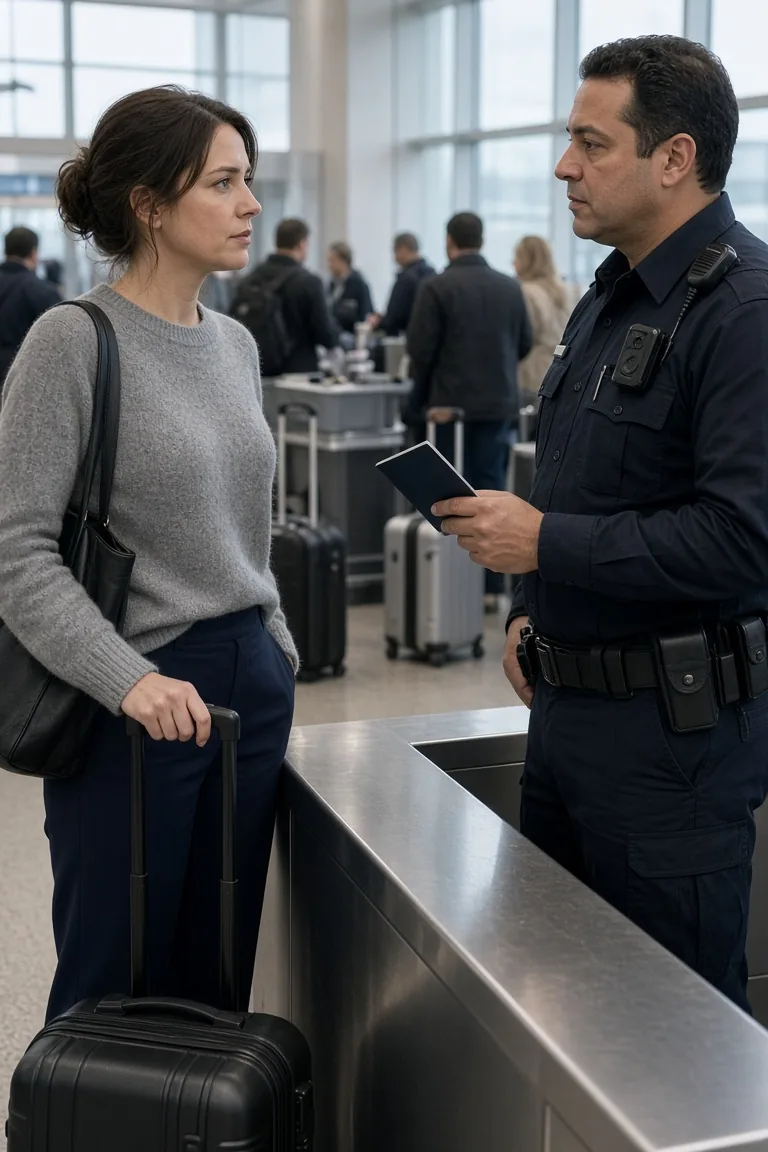
The airport was already loud when I got to the security checkpoint at Reagan National: rolling suitcases, babies crying, people slipping off shoes with one hand while checking departure boards with the other. I had a 7:10 flight to Chicago and thirty-eight minutes to make it. I was dressed for a work trip—navy slacks, a gray sweater, flats, and a carry-on that had been through more airports than I could count. Nothing about me stood out. That was the point. Then the airport police officer stepped in front of me. «Ma’am, I need to see your passport.» I paused. «I’m flying domestic.» He looked past me toward the line. «Random document check.» His tone made it clear he expected me to obey before I could decide whether the request made sense. I handed him my passport anyway. It was in the outside pocket of my handbag because I had just returned from Toronto two days earlier and hadn’t moved it back to my home safe. He opened it, flipped through the pages, and stared at the photo longer than necessary. «Is there a problem?» I asked. He didn’t answer. Around us, travelers began looking over. A woman in a camel coat shifted her toddler to the other hip. A man in a business suit checked his watch and tried not to look annoyed. The officer held the passport by both ends. Then he tore it. RRRIP. The sound cut through the checkpoint noise. He ripped the booklet clean across the middle, dropped both pieces onto the metal inspection counter, and leaned closer. «Trip’s over,» he said. «You’re not flying anywhere.» For a second, I only looked at the pieces. A passport is a strange thing to watch someone destroy. It is small enough to fit in your hand, but it carries years of movement, work, family, and proof that the world knows who you are. Seeing it torn open on a public counter felt deliberate. Not careless. Not mistaken. Deliberate. I looked up at him. He was broad-shouldered, maybe early forties, with close-cropped dark hair and a polished airport police uniform. His nameplate read OFFICER DANIEL MERCER. A body camera sat squarely in the center of his chest. «Your body camera recording?» I asked. He tapped it with two fingers and gave me a quick smile. «Every second. Got a problem?» I opened my handbag. «No,» I said. «But you do now.» His smile tightened. «What the hell are you talking about?» I took out my credential wallet and held it open where he could see it. Special Agent, Federal Bureau of Investigation. The line went quiet in the way public spaces do when everyone senses something has changed. Officer Mercer looked at the credentials, then at me. The color seemed to leave his face so quickly that even the woman with the toddler noticed. I looked directly at the camera on his chest. «Keep it running, Officer,» I said. «I want every second too.» His radio crackled. He didn’t answer it right away. Instead, he reached for the torn passport pieces as if he might put them back together. His hands had lost their confidence. «I was conducting a standard screening,» he said. «Then call your supervisor,» I replied. He did. While we waited, I stood beside the counter and watched travelers file past. Nobody spoke to me. Still, several people stayed close enough to hear. Mercer kept trying to frame the situation as confusion. «You became uncooperative,» he said quietly. «I asked one question.» «You questioned a lawful instruction.» «I asked why a domestic traveler needed a passport.» He looked away. That was when I knew this had not started at the checkpoint. Two airport police supervisors arrived first, followed by a TSA manager and an airport operations representative. Mercer spoke before anyone could ask me what happened. «She was selected for a random document check,» he said. «She became confrontational, and the document was damaged during the interaction.» I let him finish. Then I placed the two torn pieces of my passport on the counter between us. «Please preserve the body-camera footage,» I said. «And please pull every access record connected to my travel information.» One supervisor frowned. «Why would we need that?» «Because Officer Mercer knew enough to stop me before I reached the screening lanes,» I said. «And I want to know how.» Mercer’s eyes flickered toward his body camera. The TSA manager called someone from airport security operations. A few minutes later, an analyst arrived with a laptop and began reviewing access logs from the secure travel-record system. At first, he said nothing. Then he stopped scrolling. «Officer Mercer’s credentials were used to search her itinerary,» he said. The supervisor glanced at him. «When?» «Forty-seven minutes before she entered the checkpoint area.» Mercer finally spoke. «That could have been part of a routine security review.» The analyst kept reading. «There’s another search,» he said. «Yesterday afternoon.» No one said anything for a moment. Then the analyst’s expression changed again. «There’s also a body-camera administration record,» he said. «A settings change was made about twenty minutes before Agent Hayes arrived.» Mercer’s hand moved toward the camera on his chest. The supervisor caught his wrist before he could touch it. And suddenly, nobody at that checkpoint was treating my passport as the real problem anymore. A random check can be lawful. But when someone searches a traveler before she arrives, then destroys her document in public, the question is no longer whether she was delayed. It is who decided she needed to be stopped.
Part 2: The Heartwarming Resolution
The airport supervisor told Officer Mercer to step away from the checkpoint. For the first time since he had stopped me, he looked uncertain. Not embarrassed. Not apologetic. Uncertain. That difference mattered. I had spent enough time around investigations to recognize the moment when a person realizes the story they prepared is no longer controlling the room. The body camera stayed on his uniform. The supervisor assigned another officer to stand beside him while airport security operations continued reviewing the records. I asked only one thing. «Please preserve every version of that footage,» I said. «Not just what’s stored on the device. I want the upload history, the audit trail, the account activity, all of it.» The airport operations representative nodded. «We’re locking it down now.» Mercer stared at the floor. The analyst pulled up the travel-record logs again. His credentials had accessed my itinerary twice. The first search had happened the afternoon before my flight. The second was forty-seven minutes before I approached the checkpoint. Neither search was tied to a call for service, a security alert, or a supervisor’s assignment. Then they found the message. It wasn’t in my airline reservation. It appeared in a related airport operations record connected to the same account activity. IF SHE STARTS ASKING QUESTIONS, MAKE IT A TRAVEL ISSUE. Nobody had to explain what that meant. The wording was vague enough to avoid naming a crime, but not vague enough to be innocent. Someone had anticipated that I might ask questions. Someone had decided that the cleanest way to isolate me would be to turn my travel plans into a problem. The body-camera audit made the picture worse. Twenty minutes before I arrived at the checkpoint, Mercer’s camera settings had been changed through an administrative portal. The camera was still recording when he stopped me, just as he had bragged. But the configuration change affected how quickly footage would upload and which alerts would be generated if the device went offline or was tampered with. He had expected to control the record. Instead, he had created a record of someone preparing to control it. Mercer’s supervisor asked him whether he had made the change. «I don’t manage the portal,» he said. «Then who does?» He didn’t answer. The airport police chief arrived about an hour later. By then, Mercer had been removed from public duty, his access suspended, and his body camera collected as evidence. I gave a formal statement in a small airport office that smelled faintly of printer toner and burned coffee. I described the torn passport, his exact words, the way he tried to call me confrontational before anyone had heard my side. Then the FBI’s local public-corruption team was notified. The investigation uncovered that Mercer had been communicating with a civilian airport contractor who had access to certain operations records. The contractor was worried about questions being raised around a separate review involving vendor access and improper record searches. My name had surfaced during that review because I had requested information through official channels weeks earlier. They didn’t need to make me disappear. They needed to make me look difficult, delayed, unreliable, and distracted. A ruined passport and a missed flight would have done that. But Mercer had chosen the worst possible person to intimidate with an official record. He had also chosen the worst possible way to do it: directly beneath a camera he believed he could manage. The contractor was later charged for unauthorized access to protected records. Mercer was charged with destruction of property under color of authority, misuse of law-enforcement systems, and obstruction-related offenses connected to the attempted manipulation of the body-camera record. My passport was replaced. My flight was long gone. I flew out the next morning instead. Before I left, I stood at the same checkpoint with my new travel documents in hand. The lanes moved quickly. Travelers stepped forward, showed their IDs, and kept going. Nobody recognized me. That was fine. The part I remembered was not Mercer’s expression when I showed him my credentials. It was the sound of that passport tearing and the certainty in his voice when he told me my trip was over. He was wrong about the trip. But he was right about one thing: every second was recorded.
Discover more heartwarming stories and emotional moments on our main editorial page.
My Son Came Home Different: A Mother’s Concern — An Inspiring Family
Read Full Story ➡️