
Part 1: The Sunday My Son Came Home from His Mother’s House
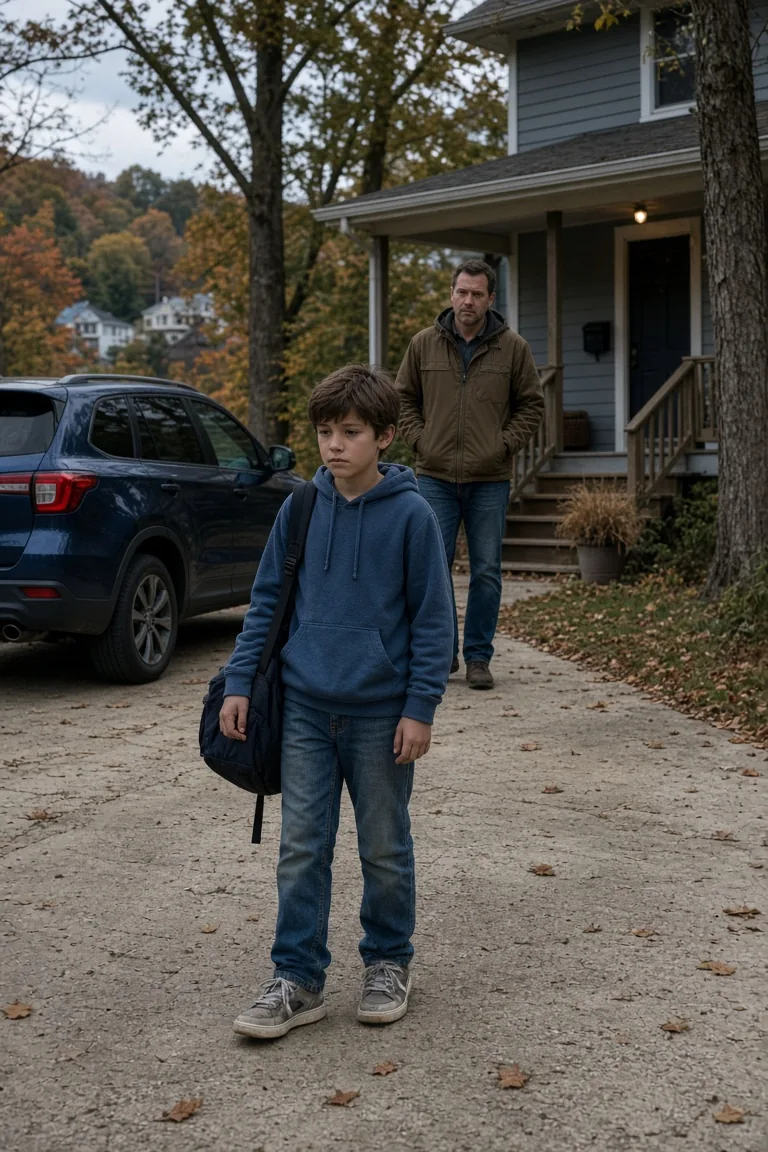
, I knew something was wrong before he said a single word. It was the way he crossed the driveway. Ten-year-old Beckett Whitaker had never understood the meaning of moving slowly. On Sunday evenings, when his mother brought him back to my house, he usually jumped out of the car before I could reach the porch. His backpack would be bouncing behind him while he told me everything that had happened over the weekend. That October evening in Asheville, North Carolina, there was no running. Beckett stepped out of his mother’s dark blue SUV and stood beside it for several seconds. His backpack hung loosely from one shoulder. His face looked tired. More troubling was the way he moved. Carefully. Almost cautiously. As if every step required thought. His mother, Mallory Vance, lowered her window. «He’s been complaining most of the afternoon,» she called. «Please don’t encourage him by turning it into something bigger than it is.» I looked at my son. «Beck?» He avoided my eyes. «Hey, buddy. Come inside.» He nodded. Mallory pulled away before I could ask another question. Inside, Beckett put his backpack beside the stairs and remained standing. «Do you want something to eat?» «No.» «Water?» He shook his head. Then he whispered, «I’m supposed to be fine.» I thought I had heard him incorrectly. «What?» He looked toward the front window, as if he were worried someone might still be watching from the street. «I’m supposed to be fine, Dad.» That sentence changed everything. I crouched down in front of him, careful not to crowd him. «You don’t have to tell me anything right now. But if something hurts, we’re going to get you checked out.» His eyes filled with tears. «Mom said it wasn’t a big deal.» I asked where it hurt. He hesitated. Then he told me he was uncomfortable and didn’t want to sit down. I didn’t interrogate him. I didn’t call Mallory and start a fight. I grabbed my keys. «We’re going to the hospital.» On the drive to Mission Hospital, Beckett barely spoke. I kept one hand on the steering wheel and the other resting near the center console. Every few minutes I asked if he was okay. Every time, he gave me the same answer. «I’m supposed to be fine.» At the hospital, the staff took us seriously. A nurse spoke to Beckett privately for part of the assessment, then asked me questions about when he had left my house, where he had been staying, and when I first noticed something was different. I told her everything. The careful walking. The refusal to sit. The exhaustion. And that strange sentence. Eventually, another staff member came into the room and asked whether Beckett had said anything about what happened at his mother’s house. Before I could answer, Beckett quietly said, «Mom told me what to say.» The room went silent. I felt my stomach drop. The hospital staff did not tell me to confront Mallory. Instead, they followed their procedures and contacted the appropriate authorities. By the next morning, investigators were involved. Mallory arrived with an explanation ready. She said Beckett had been uncomfortable earlier that afternoon but insisted there was nothing serious happening. She repeated what she had told me in the driveway. «He was fine when he left.» But investigators were not relying only on what either parent said. They began looking at the timeline. And then they found the messages. Mallory had been communicating with her boyfriend shortly before bringing Beckett back to my house. At first, she claimed the messages had nothing to do with my son. Then investigators compared the timing. One message had been sent shortly before Mallory left her house. Another came while she was driving. And suddenly, the story she had given everyone began to look very different. The messages did not prove everything investigators needed to know. But they raised questions Mallory couldn’t simply explain away. Questions about what she knew. Questions about what she had told Beckett. And, most importantly, why she had been so determined to convince me that my son was fine. I sat beside Beckett that night, listening to the quiet sounds of the hospital hallway. For the first time since he had come home, he finally seemed willing to close his eyes. I didn’t know what the investigators would find next. But I knew one thing: I was never again going to mistake a frightened child’s silence for proof that everything was okay. A parent has to decide when to trust an explanation, and when a child’s behavior is telling them something the words cannot. And sometimes protecting a child means accepting that the person giving you reassurance may be the very person whose story needs to be questioned.
Part 2: A Mother’s Concern: Signs of Struggle in Children
The messages changed the investigation. Not because one text suddenly answered every question. It didn’t. What mattered was the timeline. Investigators could see that Mallory had been talking with her boyfriend before she brought Beckett home. The messages showed that she was discussing Beckett’s condition and what she wanted him to say afterward. That was very different from telling his father, «He’s been complaining most of the afternoon.» Mallory had presented the situation as ordinary. The messages suggested she had known more than she admitted. When investigators questioned her about them, she changed parts of her story. Then she changed them again. Her boyfriend was interviewed separately. He initially tried to minimize the conversation, but investigators already had the messages. They didn’t need dramatic guesses. They had a record of what had been said and when it had been said. Meanwhile, Beckett was allowed to speak with professionals without his mother present. That mattered. He wasn’t pressured to repeat anything. He wasn’t asked to choose between his parents. He was simply given a safe place to explain what he remembered in his own words. And slowly, the pieces began fitting together. Beckett had been uncomfortable for hours before he was brought home. Mallory knew he wasn’t acting normally. She had spoken to her boyfriend about it. Then, before leaving him with me, she told Beckett he was supposed to be fine. That explained the sentence he had repeated in my house. He hadn’t been trying to convince me. He had been trying to follow an instruction from an adult he trusted. Once investigators understood that, the focus shifted from what Mallory claimed to what could actually be established. Medical records were reviewed. Messages were preserved. Statements were documented. The appropriate child-protection authorities became involved. And Mallory’s version of the afternoon became increasingly difficult to defend. I wanted to be angry. I was angry. But when I looked at Beckett, I knew my job wasn’t to make this about my anger. My job was to make sure he understood one thing. He had done nothing wrong by telling the truth. A few days later, he was sitting at my kitchen table eating grilled cheese when he suddenly looked up. «Dad?» «Yeah?» «Was I bad for telling you?» I put my sandwich down. «No.» He looked at me carefully. «You did exactly what you were supposed to do.» He was quiet for a moment. Then he asked, «Even if Mom gets mad?» I told him the truth. «Adults are responsible for their choices. You’re responsible for telling someone when you don’t feel safe or when something doesn’t feel right.» He nodded. There was no dramatic speech. No perfect ending. The investigation continued through the proper channels, and the adults involved had to answer for their decisions. But the biggest change happened at home. Beckett stopped saying, «I’m supposed to be fine.» Instead, when something bothered him, he started saying, «Dad, something doesn’t feel right.» And I listened. Because that Sunday taught me something I don’t think I’ll ever forget. Children don’t always have the vocabulary to explain what is happening to them. Sometimes they show you with the way they walk through the front door. Sometimes they refuse to sit down. Sometimes they repeat a sentence that doesn’t sound like something they would normally say. And sometimes, the most important thing a parent can do is simply believe that something is worth checking. I took my son to the hospital because his behavior didn’t match the explanation I had been given. That decision opened a door nobody in our family expected. And once investigators found the messages, the story that had been presented as «everything is fine» could no longer stand on its own.
Discover more heartwarming stories and emotional moments on our main editorial page.

The Little Girl They humbled at the Party Had No Idea Who Was Watching
Read Full Story ➡️