
This Warehouse Food Rescue begins on a rain-soaked night when Daniel, a restaurant owner with a habit of handing out extra meals to anyone who looked hungry, noticed a little girl leave his delivery box untouched. She was thin, wet, and shaking, yet she clutched the container against her chest as though it held something far more valuable than dinner. Daniel had seen desperation before, but he had never seen a child carry food like a secret. When she ran through the rain without opening the lid, he felt a hard knot form in his chest. Something about her fear, her speed, and the way she kept looking over her shoulder told him the food was not for her alone. So he followed, not to intrude, but because every instinct he had told him that a child who ran from food was running toward something much bigger than a meal.
Part 1: Warehouse Food Rescue in the Rain
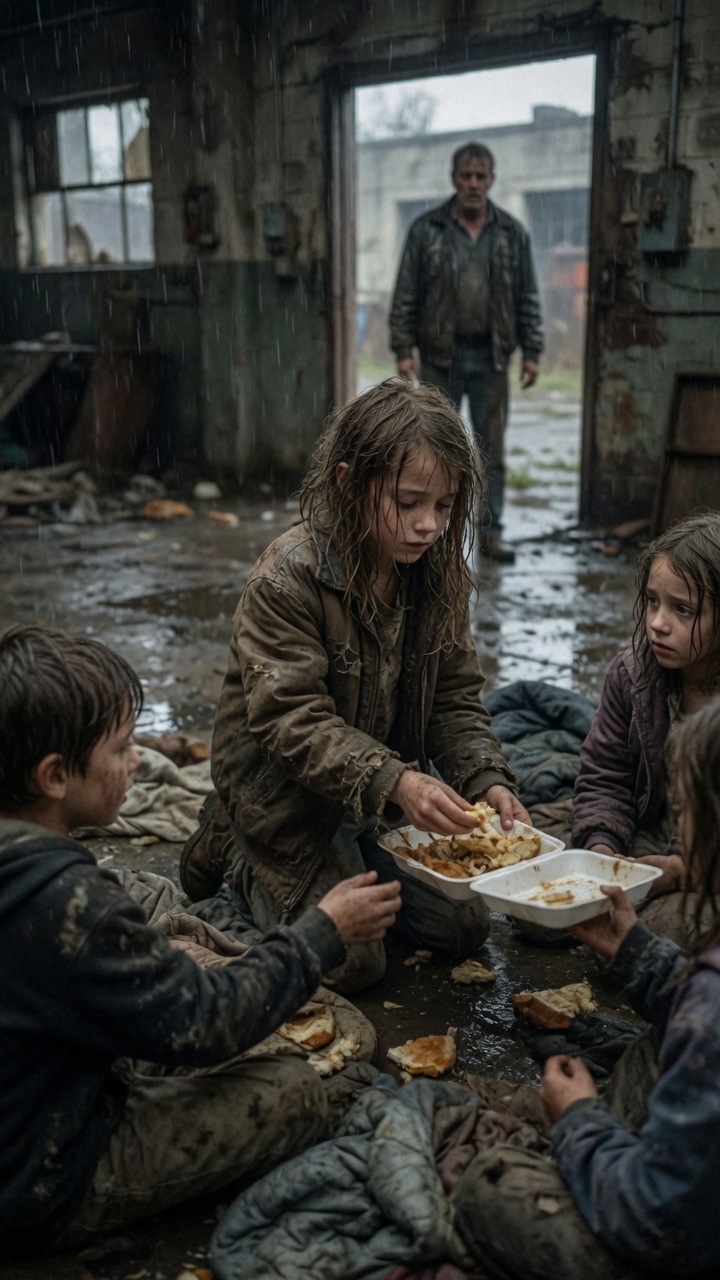
The girl crossed a row of puddles and slipped between two ruined buildings before disappearing into a rusted side door that hung open in the wind. Daniel slowed as he reached the entrance. Inside, the warehouse smelled like damp concrete, old wood, and cold air that had nowhere to go. The floor was covered with blankets, coats, and a few flattened cardboard boxes that had been arranged with care to form sleeping spaces. The sight stopped him cold. There were children everywhere. Some were too quiet. Some were too tired to lift their heads. All of them turned when the girl came back inside holding the food box close to her chest.
For a second, no one moved. Then a small boy with a cracked voice asked, “Did you get something?” The girl nodded and knelt down in the middle of the room as if she had done it a hundred times before. She opened the container and began separating the food into careful portions, placing each piece into the hands of the children around her. She gave the best pieces away first. She checked the youngest child twice before she let anyone else take a bite. Daniel watched her divide every mouthful with such seriousness that it no longer looked like sharing. It looked like duty.
One child, maybe six years old, stared at her empty hands and asked, “What about you?” The girl gave him a small smile that looked older than her face. “I already ate,” she said. But even from the doorway, Daniel could tell she had not. The lie was gentle, practiced, and obvious. It carried the weight of someone who had said it many times because the truth would have started an argument she did not have the energy to win. Daniel took one step forward, then another. The children noticed him at once. Shoulders lifted. Plates tightened in small hands. One boy pulled his blanket closer like a shield.
The girl stood up fast and moved in front of them. Not to hide herself. To guard them. “Please,” she said, her voice thin but steady, “don’t take their food.” Daniel held up both hands so they could see he meant no harm. “I’m not here to take anything,” he said quietly. “I followed you because I needed to know where you were going.” The children still did not relax. Neither did the girl. Rain drummed on the cracked roof above them. Water slid down the warehouse walls in silver lines. In the far corner, something shifted on a mattress, and a weak cough broke the silence.
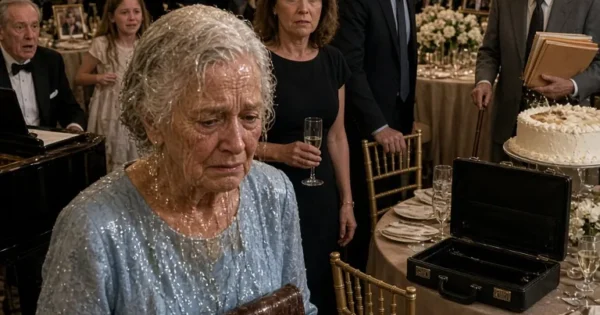
Every head turned toward the sound. Daniel looked past the children and saw an elderly woman lying on a thin mattress pushed against the wall. Her face was pale, her hair gray and thin, and her breathing looked difficult. She tried to sit up when she saw him, then froze. Her eyes widened in a way that made Daniel feel the floor tilt under him. He knew that face. Not from yesterday. Not from recent years. From long ago, from a life he had buried so deeply that even the smell of the warehouse seemed to pull old memories out of him at once.
Her lips parted. Her hand trembled as she lifted it toward him. “Daniel,” she whispered.
He could not move. He could not answer. The little girl looked from the woman to Daniel and back again, confused by the shock that had settled over the room. Daniel’s voice came out rough. “Ruth?”
The old woman closed her eyes for a second, and when she opened them again, they were wet. “I thought I would never see you again,” she said.
Part 2: Warehouse Food Rescue and the Woman Daniel Lost
Daniel walked to the mattress as if every step had to pass through memory first. Ruth was his mother. Or at least she had been the woman who raised him, tucked him in, and told him stories when he was too small to understand the world he lived in. Then, years ago, she had vanished. No note. No warning. Only absence. He had spent years wondering whether she had died, chosen to leave, or simply disappeared into a life too hard to explain. Now she was lying in front of him in a warehouse full of children, and every unanswered question in his life seemed to stand in the room with them.
“Why didn’t you find me?” he asked, though he already knew the answer would hurt. Ruth tried to smile, but it failed halfway. “I tried,” she said. “I was afraid. I was ashamed. And by the time I found a place where I could help children, I was already too far away to come back easily.” She glanced at the children around her and then at the little girl, who had quietly lowered herself to the floor again, still listening. “I could not leave them,” Ruth said. “They were sleeping on concrete. They were hungry. Nobody came for them. So I stayed.”
Daniel looked around the warehouse with new eyes. The blankets were not clutter. The boxes were not junk. The children were not trespassers. They were a family built from leftovers, cold nights, and one woman refusing to walk away. The little girl’s name was Mia, and she had become Ruth’s helper long before Daniel arrived. She carried food, sorted donations, and made sure the smallest children ate first. She had not been running from the restaurant food. She had been protecting it from the world outside. If she did not get it back quickly, someone stronger might steal it before the little ones ate.
The realization made Daniel look at Mia in a new way. She was not just cautious. She was carrying a burden far too large for a child her age. He crouched down so he was level with her and asked, “Why do you do this?” Mia hesitated, then said, “Because if I wait too long, they lose their dinner.” She looked at the other children when she spoke, not at herself. Daniel felt a deep ache move through him. No child should have to think that way. No child should have to decide who gets to eat and who waits.
That night Daniel made a decision before the rain even stopped. He called his restaurant manager, a local doctor, and a social worker he trusted. He asked for blankets, fresh food, medicine, and a van. Then he did something even bigger than that. He promised Ruth that the warehouse would not be the end of their story. It would be the place where everything started to change. By sunrise, the children had hot meals. By noon, Ruth had a proper bed and a doctor checking her breathing. By evening, the youngest children were placed somewhere warm while the older ones were given a safe room together, not split apart, not forgotten, and not treated like luggage.
Daniel did not stop there. He used part of his savings to lease a small building near the restaurant. He turned it into a community kitchen and family room with tables, clean beds, and shelves full of food. Mia helped stack plates. The boys carried boxes. Ruth, once she was steady enough to stand, sat near the window and cried only after everyone else had left the room. Daniel sat beside her and let the silence do its work. No speech could have repaired the years between them. But it was enough that he stayed.
In the weeks that followed, Daniel learned the truth piece by piece. Ruth had spent years helping children no one wanted to keep together. She had fed them from her own hands. She had hidden them when the weather turned bad. She had taught them to count meals, share blankets, and trust the sound of someone bringing food. Mia had been the first child Ruth found after one especially hard winter, and she had never left her side. Daniel understood then why the little girl had looked at the food box as though it were treasure. To her, it was not a meal. It was safety.
Months later, the warehouse was empty, but the people who had lived there were not lost. They had homes, school schedules, warm shoes, and a place to come back to each weekend. Daniel kept the doors of his restaurant open for them every Sunday afternoon. Mia no longer ran with food clutched to her chest. She sat at the table and ate without fear, then helped serve others. Ruth recovered enough to walk on her own, and Daniel began spending real time with the mother he thought he had lost forever.
The hardest part was not the warehouse. It was learning how to be family again after so many years apart. That took patience, quiet meals, and small apologies no one rushed. Ruth told Daniel she had wanted to return many times. Daniel told her he had wanted to stop waiting much sooner. Neither of them fixed the past. They simply stopped letting it control the future. And that was enough for now.
What began as a simple delivery in the rain became a Warehouse Food Rescue that uncovered a hidden family, saved a room full of children, and gave Daniel back the person he thought he had lost forever. Some meals feed a single night. Others open the door to a life that should never have been left behind.
Some stories begin with food and end with family, and this one proved that a single act of kindness can still change the shape of a whole room.