
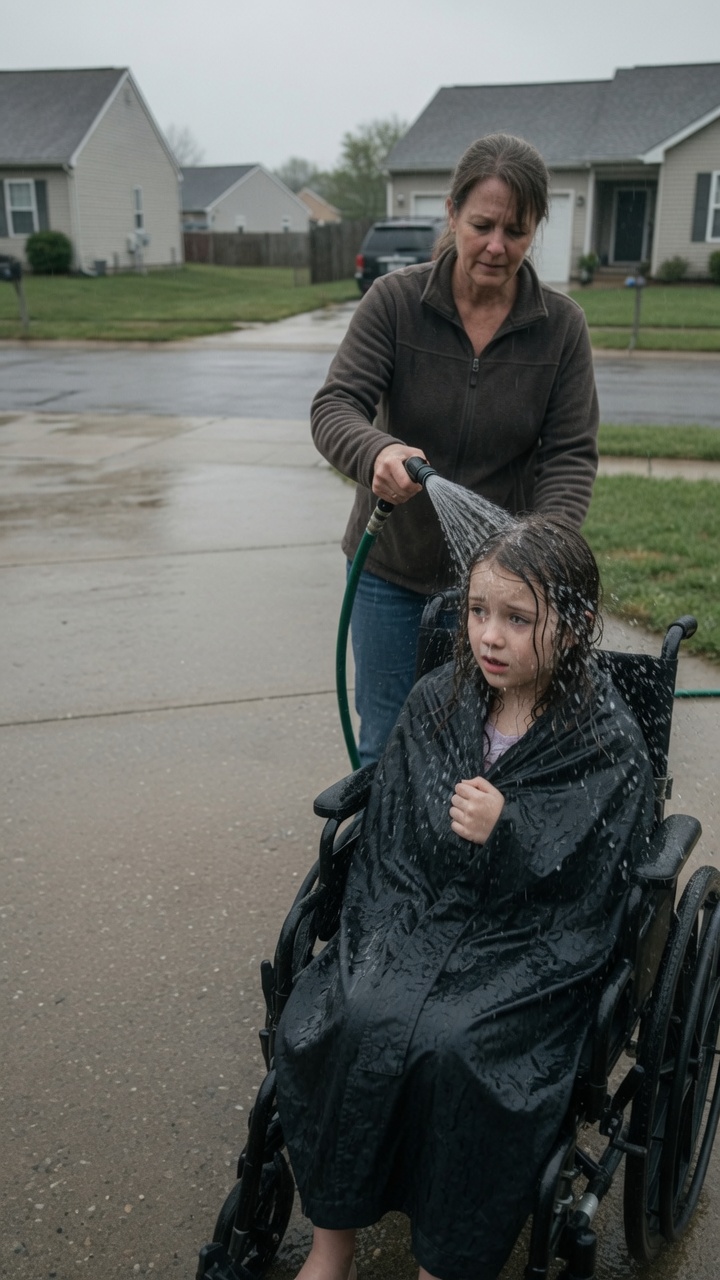

This Trust Fund Betrayal begins on a gray afternoon when I was never supposed to be home yet. A canceled meeting brought me back four days early, and I expected nothing more dramatic than an awkward surprise at the front door. Instead, I turned into my driveway and saw my eight-year-old daughter, Iris, soaked through in her wheelchair while my wife stood over her with a garden hose. The sight was so wrong that my mind tried to reject it before my body could even react. I slammed the car into park, jumped out, and ran toward them with my heart pounding so hard it felt like it had climbed into my throat. Iris looked small under the weight of the water and even smaller under the look on my wife’s face, which was calm in a way that made the whole scene feel colder than the rainless sky above us.
Part 1: The Trust Fund Betrayal Begins in the Driveway
“She needed cleaning,” my wife said as if she were talking about a porch step or a muddy pet, not our daughter. Her tone was flat, almost bored, and that made the moment worse than if she had shouted. Iris was clutching a dark blanket around her shoulders, her teeth chattering, her hair plastered to her forehead, her eyes wide with the kind of confusion children only have when adults are supposed to protect them and suddenly do not.
I dropped to my knees in front of Iris and pulled her toward me, trying to shield her from the hose with my own body. “I’m here now,” I told her, because I had no idea what else to say and because I needed her to know she was not alone. My wife lowered the hose a little but did not apologize. She just watched us with the same careful distance someone might use when watching a stranger unpack boxes.
That was when Iris did something I did not understand. She shifted her weight, pressed her hands against the wheelchair arms, and slowly, shakily stood up on her own. Not fully upright, not confidently, but enough that I saw her knees lock and her feet take her weight. I stared at her in disbelief. For more than a year I had believed she could not stand without help. Every doctor appointment, every therapy schedule, every late-night conversation had been built around that belief.
“You can stand?” I asked, my voice cracking on the second word.
Iris looked down at her own legs as if they belonged to a child she had never met. “I didn’t know,” she whispered. “I didn’t know I could.”
The words landed like a blow. Not only could she stand, but she had not even known it was possible. I looked from her to my wife, and for the first time in our marriage I felt a coldness that had nothing to do with weather. If Iris’s body was more capable than we had been told, then someone had been shaping her entire world around a lie. The question was no longer whether I had misunderstood something. The question was who had been hiding the truth from me, and why.
I helped Iris inside, dried her off, and got her settled on the sofa with a blanket and a mug of warm broth. She kept glancing toward the window as if expecting my wife to reappear and tell her she had done something wrong. My wife, meanwhile, moved through the house with a strange silence, barely speaking at all. She did not explain the hose. She did not explain why Iris was in the driveway. She did not explain why my daughter looked frightened of her own home.
After Iris fell asleep, I opened the laptop and started searching through every record I could find. The medical files were full of gaps. Therapy sessions I remembered paying for had vanished from the schedule. Specialist visits I had thought were routine were missing from billing logs. A handful of notes were signed, but the tone in them felt off, as if they had been copied and arranged to tell a story that sounded convincing from a distance and flimsy up close.
Then I checked the medical trust fund I had created for Iris’s care.
The balance was wrong.
At first I thought I was reading it incorrectly. Then I opened the statements again and again, each time feeling my pulse speed up. Money had been withdrawn in small amounts for months, then larger ones. Some of the transfers went to accounts I did not recognize. Others were written off as care expenses that I could not match to any actual treatment. The numbers formed a pattern so clear that denial became impossible.
My wife had been moving money without telling me.
I sat in the dark kitchen with the account statements spread across the table and listened to the house settle around me. A refrigerator hum. A clock ticking in the hallway. Iris breathing softly upstairs. It all felt painfully ordinary for a moment, which made the discovery worse. Nothing in the walls had warned me. Nothing in the rooms had announced that my family’s foundation was rotting from the inside.
I wanted to wake Iris and ask her what had happened, but the answer already terrified me. Children do not invent their own limitations out of nowhere. They learn them from the people around them. The more I looked at the records, the more I understood that someone had not just been managing Iris’s care badly. Someone had been controlling the shape of her life.
At the bottom of the stack of papers, tucked into a page of appointment notes, I found a folded slip of paper. It was one of Iris’s drawings. On the front, our house was drawn in shaky pencil lines. On the back, in small uneven handwriting, she had written, “Daddy, Mommy said don’t tell you.”
I read those words over and over until the ink seemed to blur. Then I sat there in the kitchen long after midnight, staring at the drawing and realizing that whatever truth I was about to uncover, my daughter had already been carrying part of it alone.
Part 2: The Truth Behind the Trust Fund Betrayal
The next morning I arranged an independent evaluation for Iris without telling my wife. I drove her to a pediatric rehabilitation team two towns over, away from the names and records my wife had controlled. Iris looked nervous at first, but the staff spoke to her gently, as if she were a child with possibilities instead of a problem to be managed. They asked her to shift, balance, reach, and stand when she felt ready. Each time they gave her a chance, she looked surprised that no one was telling her she could not try.
By the end of the evaluation, the lead physician asked to speak with me privately. He did not sound shocked, only deeply concerned. He explained that Iris did have real physical challenges, but not nearly to the extent we had been led to believe. With steady therapy and honest support, she had been capable of far more movement than the old notes suggested. More important, there was no medical reason she should have been discouraged from trying to stand or practice strength-building exercises for as long as she had been.
That was the moment the last of my doubt disappeared.
When I came home, I spread every record I had found across the dining room table and asked my wife to sit down. She looked at the papers, then at me, and immediately understood the kind of trouble she was in. For a few seconds she still tried to hold on to denial. She said there had been bookkeeping mistakes. She said she had been overwhelmed. She said she never meant for anything to go this far.
Then I showed her the withdrawals, the missing sessions, the altered timelines, and the notes that did not line up with the real treatment schedule. Her face changed. Not into guilt exactly, but into the exhausted expression of someone who has run out of ways to keep a lie standing.
She admitted she had been moving money out of Iris’s trust fund for months, telling herself she would replace it later. Debt had piled up. Bills had followed. Shame had made her secret grow. But the money was only part of the damage. To keep the gaps hidden, she had canceled appointments, delayed therapy, and built a false story around Iris’s condition so the missed care would not be questioned too quickly.
What she had done to the finances was bad enough. What she had done to Iris was harder to forgive. Our daughter had spent months believing her body was weaker than it was, because the adults she trusted kept acting as if every attempt to stand was a mistake.
I called a lawyer that afternoon. Then I called the bank. Then I called the rehabilitation team again and asked them to start as soon as possible. Investigators reviewed the trust fund transfers. The account that was supposed to secure Iris’s future was now part of a formal recovery process, and the legal damage would take time to unwind. My wife moved out while the custody arrangement was reviewed. There were no dramatic speeches, no clean ending, no way to pretend we could just patch the house back together and keep living as before.
But Iris began healing in the one way that mattered most.
She started trying.
At first she stood only for a few seconds at a time with a therapist beside her. Then she managed a few careful steps along the hallway. Later she crossed the living room while holding my hand, then one day she took my hand only at the very end, as if she had started to trust the floor beneath her more than the fear above it.
I will never forget the afternoon she made it from the couch to the front porch on her own. It was not graceful. It was not fast. She paused twice, breathed hard, and narrowed her eyes at her own feet like she was negotiating with them. When she reached the doorway, she turned back with a small, stunned smile and said, “I think I forgot I could do this.”
I knelt beside her, careful not to overwhelm the moment. “You didn’t forget,” I told her. “Someone just kept you from knowing.”
The truth of that sentence stayed with me. Money can be recovered. Records can be corrected. A trust fund can be rebuilt. But confidence is more delicate. It has to be returned one patient step at a time, and the person who was misled has to be given room to believe their own body again.
The house is quieter now, but not empty in the same way it was before. Iris laughs more. She asks to practice walking on good days. She keeps a little drawing pinned near her bed now, right where she can see it each morning: a child standing in a driveway, head raised, arms open, not because everything is fixed, but because she finally knows she was never as powerless as someone wanted her to believe.
Some betrayals steal money, and some steal time, but the deepest ones steal a child’s faith in her own strength.