
Part 1: She Crossed the Finish Line Alone—Then the Volunteer Saw Bib Number 17
The cheering stopped when the little girl crossed the finish line alone.
It was supposed to be one of those bright Saturday mornings when everything felt easy. The charity race had filled several downtown blocks, runners moved toward the finish line in waves, and families crowded behind the barriers with phones raised and children calling out names.
Volunteers handed out water and medals beneath the morning sun.
Then the little girl appeared.
She wasn’t running beside a parent, a coach, or a team.
She was alone.
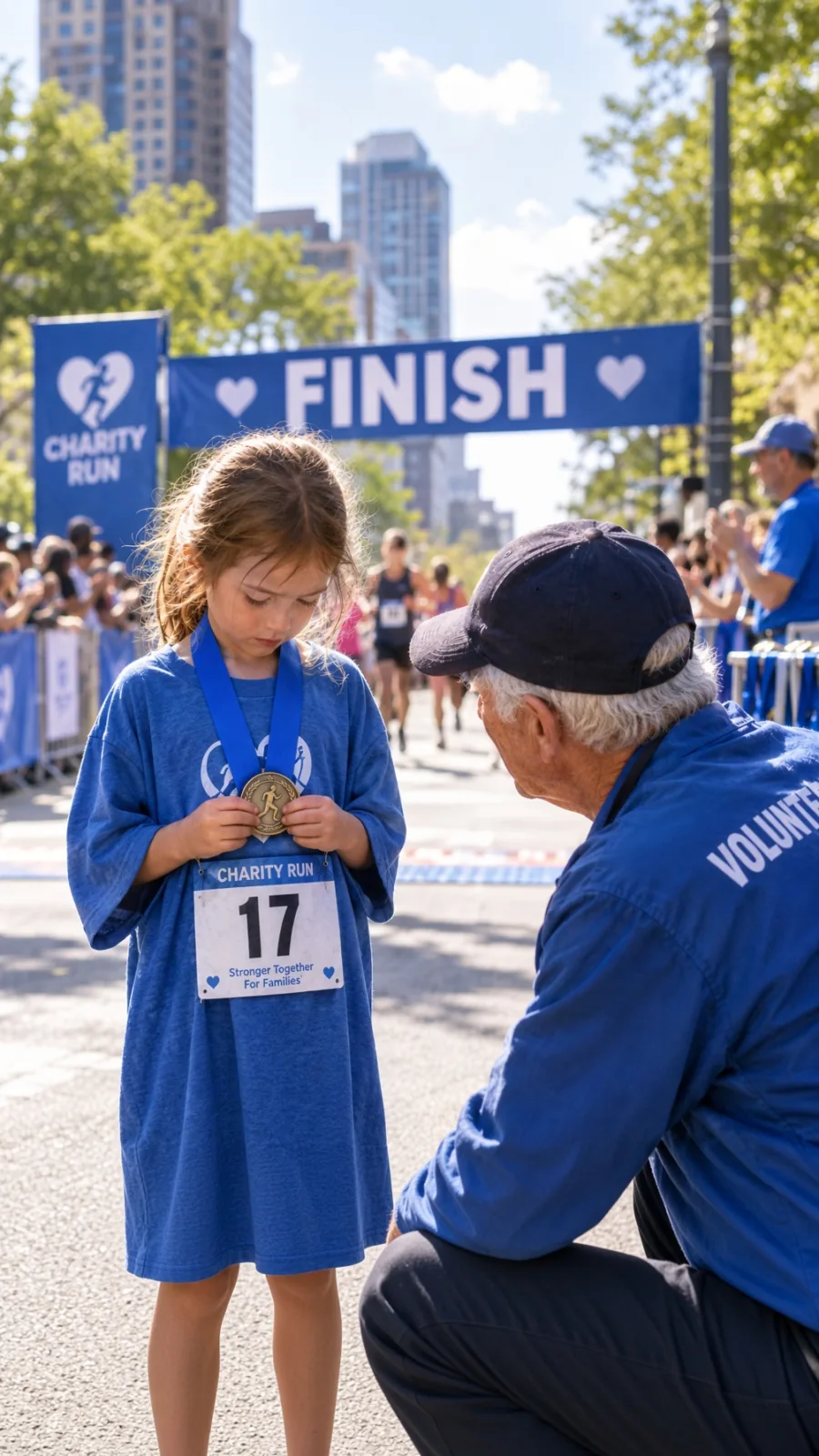
Her race shirt was much too big for her, the sleeves hanging past her shoulders. A medal rested against the front of the shirt, almost comically large on such a small frame.
One of the organizers stepped toward her.
«Sweetheart… where’s your team?»
The girl looked down at the medal.
For a moment, she didn’t answer.
Then she quietly said, «My mom ran this every year.»
Something changed along the finish line.
The noise didn’t disappear all at once. It simply began to thin out. A few conversations stopped. One runner slowed to a walk. Someone lowered a phone.
The girl kept one hand around the medal.
She wasn’t smiling.
She looked like someone who had been given a job that mattered too much to fail.
An elderly volunteer standing nearby had been watching her from behind the finish-line table. He had spent years helping with the race, handing out water, checking bibs, directing runners, and watching the event grow from a small community effort into something much larger.
Then his eyes moved from the medal to the race bib pinned to the girl’s shirt.
He stopped.
The number was clear.
17.
The volunteer stared at it.
His expression changed before he said a word.
Number 17 wasn’t an ordinary race number.
It had been reserved every year for one particular runner.
A woman who never missed the charity race.
A woman whose name had become tied to the event itself.
A woman who had once spent months finding sponsors, organizing volunteers, bringing runners together, and raising money for struggling families.
The same woman who wore bib number 17 every year.
The little girl noticed the volunteer staring.
She looked down at the number herself.
Then she whispered, «She told me to finish it.»
The old volunteer didn’t move.
Around him, runners who had been walking away began stopping again.
The finish line had become strangely still.
The girl held the medal with both hands now.
«Mom said people needed it.»
That sentence landed harder than anyone expected.
Because the race wasn’t simply something her mother had participated in.
It had been her dream.
For years, she had worked to keep the event alive because she believed the money raised could help families who were struggling.
The volunteer remembered those early mornings. Folding tables. Boxes of supplies. Last-minute phone calls. People asking whether they had enough sponsors to continue.
And he remembered her bib.
Always 17.
Always pinned to her shirt.
Always somewhere near the front of the race.
Now that same number was pinned to a little girl’s oversized shirt.
The volunteer finally walked toward her.
He lowered himself until they were closer to the same height.
The girl watched him carefully.
He looked at the bib again.
Then at her face.
Then back at the number.
«Your mom…» he began.
His voice failed him for a second.
The little girl waited.
The volunteer swallowed and finished the thought.
«Your mom started this charity.»
The words seemed to leave the entire finish line without an answer.
No one cheered.
No one moved forward.
For a few seconds, hundreds of people simply stood there, looking at a child who had crossed a finish line by herself.
The girl wasn’t carrying a trophy.
She wasn’t there to win anything.
She had simply done what her mother had asked her to do.
Finish the race.
But there was still something the people standing there didn’t know.
Why had her mother wanted her to cross that line?
And what did bib number 17 mean beyond the number printed on a piece of paper?
The answer was waiting in the story behind the race itself.
Would you have let the child finish alone, knowing what the race meant to her mother? Or would you have stopped the race and taken her aside first? Both choices come from a place of care, but only one preserves the promise she came to keep.
The strange part wasn’t that she had bib 17. It was who had been given that number before her.
Part 2: The Heartwarming Resolution
(Part 2)
The volunteer stayed beside the little girl at the finish line.
For a moment, neither of them spoke.
The crowd was still watching.
The runners who had been heading toward the water tables had stopped. Families behind the barriers stood quietly, and even the volunteers seemed unsure whether they should continue handing out medals.
The little girl looked at the old volunteer.
«Did you know my mom?»
He nodded.
«I did.»
She waited.
He looked toward the finish line, then back at her.
«Long before this race looked like this.»
The girl listened.
The volunteer remembered the first years.
There had been no huge crowd then. No packed sidewalks. No long rows of runners. No complicated finish-line setup.
There had simply been one woman with an idea.
She wanted to raise money for struggling families.
So she called people.
She found sponsors.
She recruited volunteers.
She convinced runners to participate.
When something went wrong, she stayed late and fixed it.
When donations were low, she found another way.
And every year, when the race began, she wore the same number.
17.
The number eventually became associated with her.
People didn’t ask where bib 17 was.
They asked whether she had arrived yet.
The volunteer remembered seeing her near the starting line year after year.
She never acted like the race belonged to her.
She acted like it belonged to everyone who needed it.
The little girl looked at the medal hanging from her neck.
«She said I had to finish.»
The volunteer nodded slowly.
«She knew you’d understand.»
The girl looked up.
«Did she tell you?»
He shook his head.
«No.»
That answer seemed to surprise her.
Then the volunteer explained why he understood anyway.
Her mother had spent years telling everyone the same thing whenever the race became difficult.
The event mattered because the people receiving the help mattered.
The race wasn’t about who finished first.
It was about making sure somebody who was struggling didn’t have to face everything alone.
That was why she kept returning.
That was why she kept bib 17.
And that was why seeing it on the little girl’s shirt had stopped him cold.
The volunteer looked at the crowd.
Then he looked back at the girl.
«You finished it,» he told her.
She gave a small nod.
For the first time that morning, she smiled.
The volunteer stood and turned toward the runners.
He didn’t make a speech.
He didn’t need to.
He simply held up the little girl’s race bib so the people closest to the finish line could see the number.
17.
One runner recognized it.
Then another.
A woman behind the barrier covered her mouth.
Someone quietly said the mother’s name.
The story moved through the crowd without anyone needing to announce it.
The woman who had built the charity race was gone.
But the race was still there.
The sponsors were still there.
The volunteers were still there.
The families she had wanted to help were still there.
And now her daughter had crossed the same finish line wearing the same number.
The little girl looked down the long stretch of road behind her.
Hundreds of runners were still arriving.
For a moment, she seemed to realize that she had not really been alone.
The people her mother had brought together were all around her.
The volunteer crouched beside her one more time.
«Your mom was right,» he said quietly.
The girl looked at him.
«About what?»
«People needed it.»
She nodded.
Then she reached up and touched the medal.
The crowd slowly began to applaud.
It wasn’t the loud, celebratory cheering from earlier.
It was slower.
Softer.
Almost like a thank-you.
The girl stood at the finish line and listened.
She hadn’t won the race.
She hadn’t been the fastest runner.
She hadn’t even had a team beside her.
But she had carried one promise across the finish line.
Years from now, people might forget the winning time from that race.
They might forget who finished first.
They might forget the weather.
But the people standing there that morning would remember bib number 17.
They would remember the little girl in the oversized race shirt.
And they would remember the woman whose dream had become bigger than the person who started it.
The volunteer watched the girl walk away from the finish line, her medal still hanging against the oversized shirt.
She had arrived alone.
But by the time she crossed the line, everyone understood that she had been carrying an entire legacy with her.
The little girl crossed the finish line for her mother, and the charity race became the proof that one person’s compassion can keep moving long after they are gone.
She didn’t just inherit bib 17. She inherited the reason her mother wore it.
Discover more heartwarming stories and emotional moments on our main editorial page.

My Husband Sent Me to facility for $2 Million, Then My Father Found
Read Full Story ➡️