
Part 1: The Unexpected Encounter at Chicago Union Station
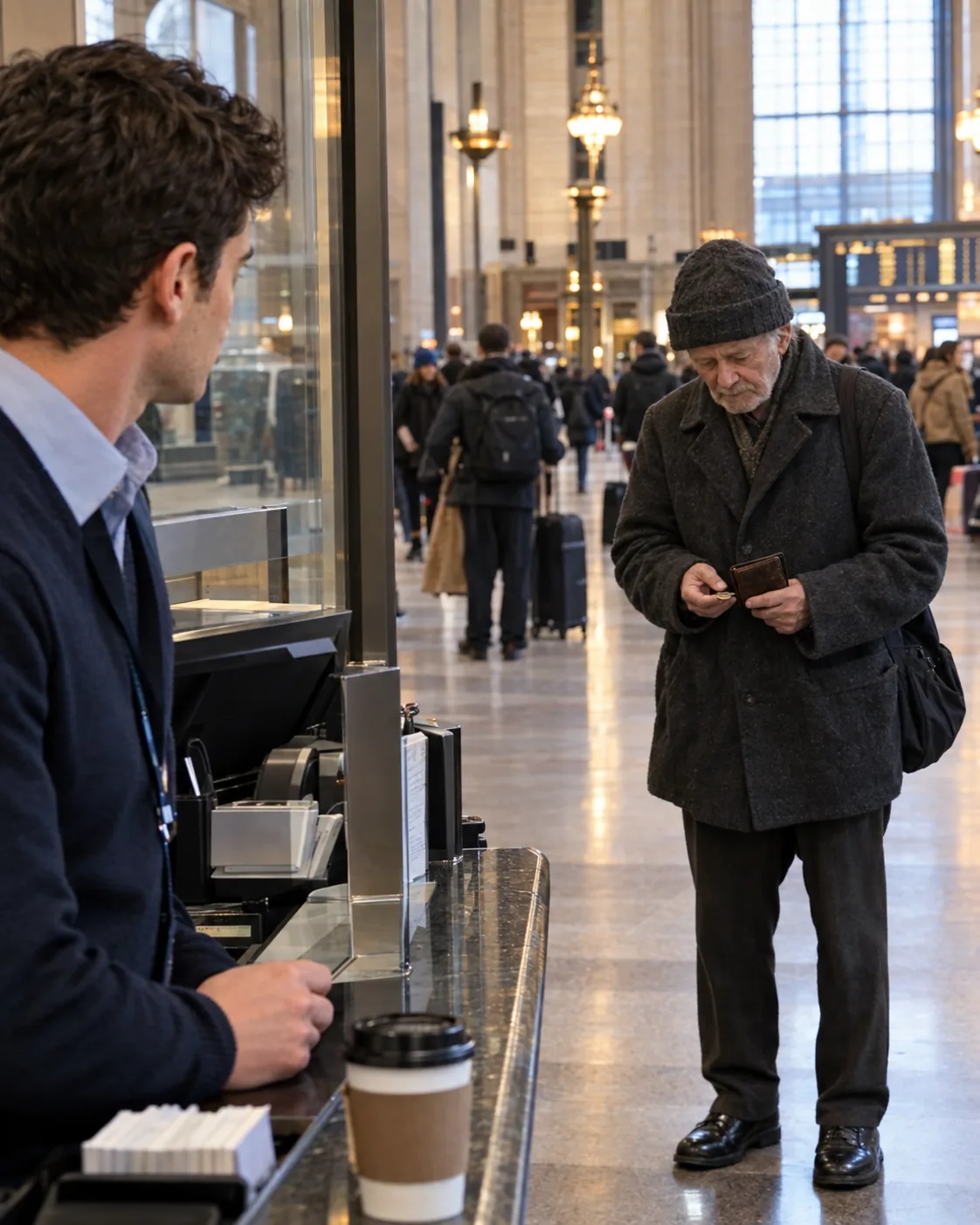
The old man had been standing near the ticket machines at Chicago Union Station for nearly ten minutes before anyone really looked at him. Outside, January snow had turned gray along the curbs. Inside, commuters hurried beneath the high ceiling with coffee cups in their hands, suitcase wheels rattling across the floor, and announcements echoing through the morning rush. At one of the counters, Matteo Russo was already behind schedule. The line in front of him seemed to grow every time he finished helping someone. Then he noticed the old man. He wore a coat that looked too thin for the Chicago cold, a worn wool hat, and shoes polished carefully despite their age. A small wallet was tucked close against his chest. Every few seconds, he looked toward the counter. Then he looked down at the coins in his hand. When the line finally shifted, the old man stepped toward Matteo. «Excuse me,» he said quietly. «Can I still get to Indianapolis before noon?» Matteo glanced at the clock. «If you leave soon, yes.» The old man nodded with visible relief. «To Indianapolis,» he repeated. «I have to be there before noon.» Matteo entered the trip information and gave him the price. The old man opened his wallet. He counted his bills. Then the coins. Then counted everything again. Matteo watched his expression change. «Do you have identification with you?» Matteo asked, trying to understand whether there was another way to help. The old man hesitated. «Yes.» «Then that should be fine.» The man lowered his voice. «I have it. But I’d rather not cause any problems.» Matteo looked again at the amount of money on the counter. The old man was almost twenty dollars short. For someone else in the crowded station, it might have meant another coffee, lunch, or parking. For this man, it was the distance between him and Indianapolis. Behind him, someone in line sighed loudly. «Are we moving or not?» The old man immediately began gathering his coins. «It’s all right,» he said. «I’ll figure something out.» Matteo stopped him. «Wait.» The old man looked up. Matteo opened his own wallet, took out a twenty-dollar bill, and placed it beside the money already on the counter. The people behind him went quiet. Matteo printed the ticket. «There,» he said softly. «You’re leaving this morning.» The old man stared at him. «Why?» Matteo gave a small shrug. «Because you have to get to Indianapolis today.» For a moment, the old man said nothing. Then he took the ticket. His hands looked steady, but Matteo noticed the slight tremor when he folded it. Before turning away, the man placed a small folded piece of paper on the counter. Matteo barely noticed it. The old man was already walking toward the departure board. The line immediately started moving again. Matteo helped a woman traveling to Milwaukee. Then a businessman who wanted to change his reservation. Then a college student whose phone battery had died. Almost fifteen minutes passed before Matteo remembered the folded paper. He opened it. The station noise seemed to disappear. There were only a few handwritten words inside. You helped me when you believed I had nothing to offer you. Below that was a name Matteo recognized immediately. Not because he had ever met the man. Everyone in his family knew the name. Matteo looked toward the waiting area. The old man was gone. And suddenly, Matteo understood that the stranger he had just helped might not have been a stranger at all. Was kindness still kindness when you never expected anything in return? Or did Matteo’s decision matter precisely because he had no idea what that small twenty-dollar bill might eventually mean?
Part 2: A Moment of Compassion and Understanding
(Part 2) Matteo read the note three times. The name at the bottom was Antonio Russo. His grandfather. Or at least, that was impossible. Antonio Russo had been Matteo’s grandfather’s older brother. Matteo had heard stories about him since childhood, always told in fragments around crowded family tables. Antonio had left the family decades earlier. Some relatives said there had been an argument over money. Others said he had disappeared after refusing to take over the family business. Nobody seemed to know the full story. But everyone agreed on one thing. Antonio Russo had vanished. Matteo was staring at the note when his supervisor approached. «You okay?» Matteo quickly folded the paper. «Yeah. I think so.» But he wasn’t. During his lunch break, Matteo called his mother. When she answered, he asked one question. «Did Uncle Antonio have a scar near his left eyebrow?» There was a long silence. «Why are you asking me that?» Matteo described the old man. The thin coat. The hat. The careful shoes. The trip to Indianapolis. His mother became quiet again. Then she said, «Matteo, Antonio would be almost eighty now.» Matteo looked at the note. «Where did he go?» His mother exhaled slowly. «No one really knew.» That answer bothered Matteo more than anything else. At the end of his shift, he asked station staff whether anyone remembered seeing the old man board the Indianapolis train. A conductor confirmed that an elderly passenger matching the description had boarded shortly before departure. Matteo went home thinking about the note. He expected the story to end there. It didn’t. Two days later, his mother called. Her voice sounded different. «Someone came to the house.» Matteo sat up. «Who?» «A lawyer.» Matteo almost laughed. «What kind of lawyer?» «One who says he represents Antonio.» The silence that followed felt heavier than the station had that morning. According to the lawyer, Antonio Russo had spent decades living quietly in Indiana. He had never become wealthy in the way the family had imagined. In fact, for years, he had lived an ordinary life, working maintenance jobs and later volunteering at a community center. But he had never completely forgotten his family. The reason he had returned to Chicago was not to ask anyone for money. He had come because his health was failing, and he wanted to settle something that had followed him for most of his life. Years earlier, Antonio had discovered that the argument that separated him from his brother had been built on a misunderstanding. A letter had been hidden. Money had gone missing. Each brother had believed the other was responsible. By the time the truth became clear, pride had already done the damage. Antonio had spent years trying to convince himself that it was too late to go back. Then, apparently, he decided it wasn’t. The lawyer explained that Antonio had planned to visit Matteo’s family before returning to Indianapolis. But after arriving in Chicago, he had become overwhelmed. He didn’t know whether anyone would recognize him. He didn’t know whether he would be welcome. So he went to Union Station. And then he stood near the ticket machines, counting every dollar he had left. Matteo listened without speaking. «There’s something else,» the lawyer said. Antonio had left instructions. He wanted Matteo to receive a letter. The letter arrived the next morning. This time, Matteo opened it at his kitchen table. Antonio wrote that he had watched Matteo at the counter before asking for help. He had seen people become impatient. He had seen Matteo stay calm. And when Matteo paid the missing twenty dollars, Antonio understood something. Not who Matteo was. At least, not at first. But what kind of person he was. Antonio explained that he had recognized the Russo name on Matteo’s employee badge only after the ticket was printed. He had wanted to tell him everything. But he couldn’t. Not yet. He was ashamed. So he left the note instead. At the end of the letter, Antonio wrote that Matteo had reminded him of the brother he had spent too many years blaming. That evening, Matteo and his mother drove to Indianapolis. Antonio was waiting in a modest assisted-living apartment near the city. When Matteo entered, the old man looked exactly as he had at the station. The same tired eyes. The same careful posture. Only this time, he smiled. «You got my note,» Antonio said. Matteo nodded. «You could have told me who you were.» Antonio looked down. «That would have made it easier for me.» They sat together for a long time. No dramatic apology fixed everything. No single conversation erased decades. But Antonio met his family again. Slowly. Carefully. And honestly. Matteo never accepted repayment for the twenty dollars. He told Antonio it had never been about the money. Antonio smiled at that. «Good,» he said. «Because neither was my note.» Months later, Matteo was still working behind the same counter at Union Station. People still rushed. Announcements still echoed overhead. And sometimes someone would stand there counting coins, embarrassed by what they couldn’t afford. Matteo never forgot that morning. Because you rarely know what someone is carrying when they stand in front of you. And sometimes the smallest kindness reaches much farther than the person who offers it will ever see. An elderly man in a thin winter coat stands quietly at a busy Chicago Union Station ticket counter while a young ticket seller notices the coins in his hand.
Discover more heartwarming stories and emotional moments on our main editorial page.
The Little Girl Who Sat Beside Him Knew the Name No One Had Spoken in
Read Full Story ➡️