
Marcus Reed never imagined a fifteen years later promise would walk through his struggling shop’s door wearing a professional suit and carrying seven coins from a childhood memory.
Part 1: A Free Ice Cream Changes Everything
Marcus Reed’s hand froze on the soft-serve lever when the little girl asked him the same question for the third time.
«You mean it?»
Marcus looked at the oversized cone in her tiny hands.
Chocolate was already sliding down one side, threatening to drip onto her hoodie.
«I mean it.»
The girl didn’t move.
Then she took the smallest lick.
Her eyes closed.
It lasted only a second, but Marcus noticed.
There was no excitement for the crowd around them.
No jumping up and down.
No attempt to make anyone notice.
She simply stood there, savoring it like she was afraid the moment might disappear.
Marcus looked away.
He’d been selling ice cream long enough to know that customers usually forgot what they ordered before they reached the sidewalk.
But this felt different.
The girl opened her hand and showed him a few coins.
«You can have these.»
Marcus shook his head.
«No. Keep them.»
«But—»
«Keep them.»
She hesitated before putting the coins into her hoodie pocket.
«What’s your name?» Marcus asked.
«Emily.»
«Well, Emily, enjoy your ice cream.»
She nodded and disappeared into the crowd.
Marcus expected that to be the end of it.
Three days later, she came back.
This time she didn’t ask for anything.
She quietly placed a folded piece of paper on the counter and walked away.
Marcus opened it after she left.
It was a child’s drawing.
A crooked ice cream cone.
A smiling man in a blue apron.
And underneath it, in shaky pencil: Thank you for seeing me.
Marcus folded the paper carefully and slipped it into his wallet.
He had no idea that drawing would stay with him for fifteen years.
The cart eventually became a truck.
The truck became a small shop.
Marcus worked through bad seasons, economic downturns, long days, and the ordinary problems that come with trying to keep a small business alive.
Then his mother became ill.
The medical bills arrived faster than he could pay them.
Loan payments piled up.
Competition grew.
At forty-three, Marcus found himself sitting alone in the back office of the shop on a rainy November afternoon, staring at overdue notices spread across his desk.
The bank had given him thirty days.
Thirty.
After nearly two decades of work, the shop he had built might be gone.
Marcus rubbed his eyes and opened the desk drawer.
The old drawing was still there.
The paper had yellowed.
The pencil had faded.
But those five words were still visible.
Thank you for seeing me.
A knock came from the front.
«Marcus?» one of his employees called.
«There’s someone asking for you.»
Marcus closed his eyes.
«Tell them we’re closed.»
«She says she came a long way.»
Something about that made him stand.
When Marcus walked to the counter, a young woman was waiting.
She wore a professional suit.
Her dark hair was neatly arranged, and she carried herself with the confidence of someone accustomed to being taken seriously.
Still, there was something familiar about her eyes.
«Can I help you?»
The woman gave him a nervous smile.
«You probably don’t remember me.»
Marcus searched her face.
Nothing.
Then she reached into her purse.
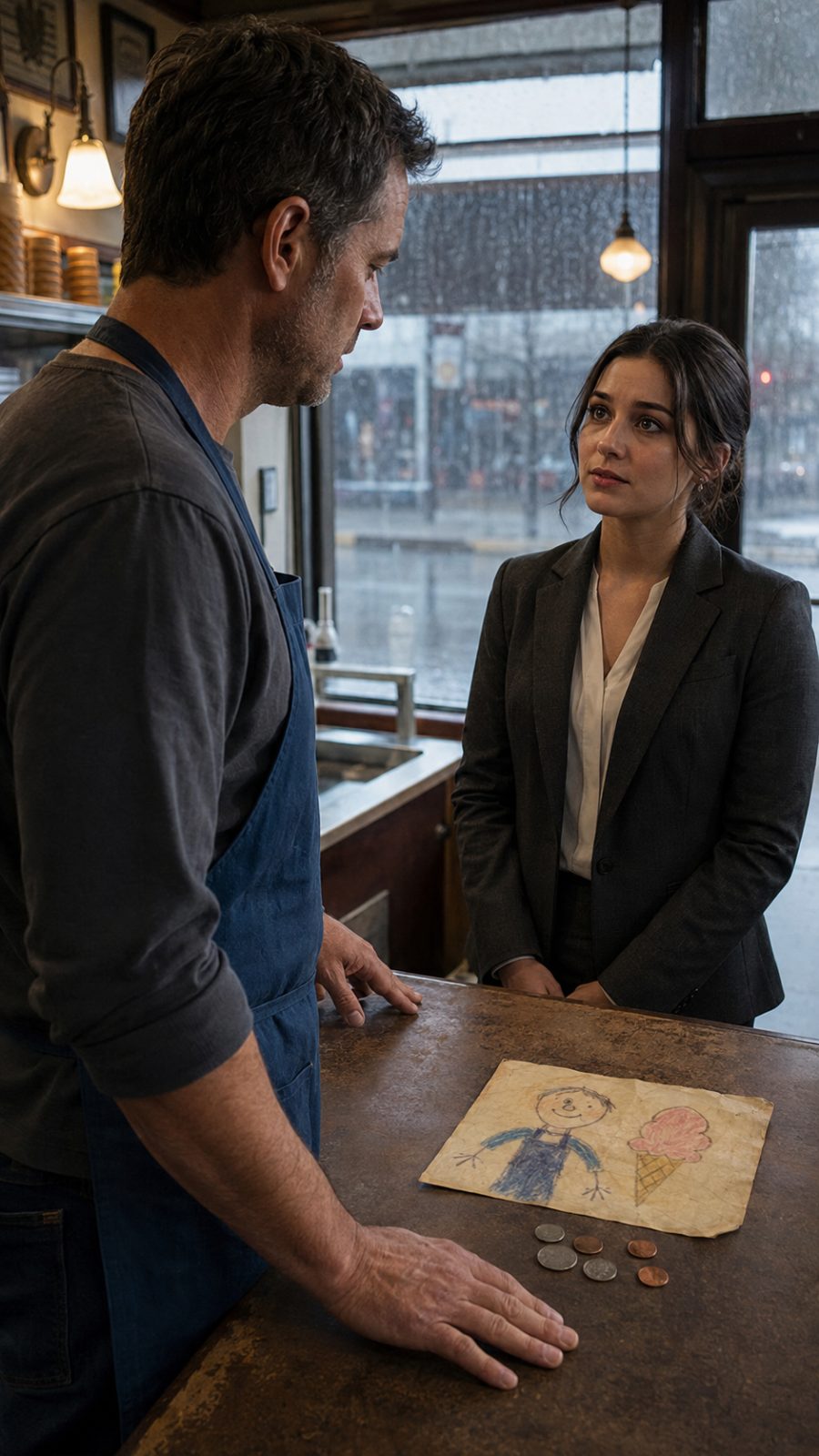
She placed three objects on the counter.
Two quarters.
One nickel.
Three pennies.
Marcus stared at the coins.
His entire expression changed.
«I never forgot,» she said.
Then she unfolded a faded child’s drawing he hadn’t seen in fifteen years.
And Marcus realized the stranger standing in front of him was the little girl he’d once thought he’d never see again.
Would you have helped her back then if you knew what it might cost you later?
And if you were Marcus now, would you accept help from someone whose life you once changed?
Marcus kept that drawing for fifteen years.
But the coins she brought back were the part he never expected to see again.
Part 2: The Return That Saved a Shop
Marcus didn’t touch the drawing.
For several seconds, he just stared at the coins beside it.
Two quarters.
One nickel.
Three pennies.
The same coins Emily had tried to give him fifteen years earlier.
«You kept them?» he finally asked.
Emily nodded.
«I kept the drawing too.»
Marcus looked up at her.
She wasn’t the little girl from the ice cream cart anymore.
She was a grown woman standing in his struggling shop, carrying herself with the calm confidence he’d only seen in people who had already learned how hard life could get.
«I wanted to come back sooner,» she said.
Marcus glanced toward the office.
«You didn’t have to.»
«I know.»
That answer made him look at her again.
Emily told him what happened after that afternoon.
Her family had been struggling badly.
The free ice cream had not fixed anything.
Marcus hadn’t magically changed her circumstances.
But that moment had stayed with her.
Someone had looked at her without treating her like a problem.
Someone had let her keep what little money she had.
Someone had seen her.
The drawing had been her way of saying thank you when she was too young to explain what that meant.
As Emily grew older, she kept it.
She worked.
She studied.
She built a career.
And eventually, she became successful enough to start helping other people who were trying to build something of their own.
Marcus listened quietly.
Then Emily slid a folder across the counter.
«I heard about the bank.»
Marcus looked down.
Inside were documents concerning an investment that would give his shop the breathing room it needed.
He immediately pushed the folder back.
«No.»
Emily didn’t move.
«You don’t even know what you’re saying no to.»
«I know exactly what I’m saying no to.»
Marcus looked toward the front windows, where rain streaked the glass.
«I gave a kid an ice cream cone fifteen years ago.
I didn’t do it expecting something back.»
«I know,» Emily said.
«That wasn’t a business transaction.»
«I know.»
«Then why are you here?»
Emily looked at the old drawing between them.
«Because it wasn’t a transaction for me either.»
Marcus said nothing.
Emily explained that she wasn’t trying to buy his business or turn his kindness into a debt.
She wanted to invest because she believed the shop deserved the chance to survive.
And because Marcus had once given her something she could not afford, she wanted to give him something he couldn’t afford to lose.
A chance.
Marcus finally opened the folder again.
The numbers were real.
The terms were clear.
There was no hidden condition requiring him to hand over the shop.
No demand that he change who he was.
No attempt to own the story.
Just an opportunity.
Marcus looked at Emily.
«You really remembered all this?»
She smiled.
«I remembered how you made me feel.»
He looked down at the drawing.
The little cone.
The crooked smile.
The faded pencil.
Fifteen years had passed, but the message still felt exactly the same.
Thank you for seeing me.
Marcus accepted the investment.
Not because Emily owed him.
Because she didn’t.
And that was what made the gesture mean something.
The shop survived.
Marcus eventually expanded the menu and hired another employee.
But he never forgot the lesson that began with one free ice cream cone.
Sometimes kindness doesn’t come back in the form you expect.
Sometimes it takes fifteen years.
Sometimes it arrives wearing a suit and carrying the same seven coins you once told a child to keep.
And sometimes the person you thought you were helping was quietly learning how to help someone else.
Marcus never became wealthy because of Emily.
He became something he valued more.
He became proof that a small act can travel farther than the person who started it will ever know.
Would you accept help from someone you once helped, even if accepting it meant admitting you couldn’t save everything by yourself?
Or would pride make you refuse?
The drawing survived fifteen years.
So did the lesson behind it: sometimes people remember the way you treated them long after you’ve forgotten the moment.
A struggling shop owner studies an old child’s drawing and seven coins as a professionally dressed young woman reveals their connection from fifteen years earlier.
Discover more unforgettable stories and truth revelations on our main editorial page.

Missing Billionaire Heiress Walks Into Jewelers for $20, Finds Crest
Read Full Story ➡️