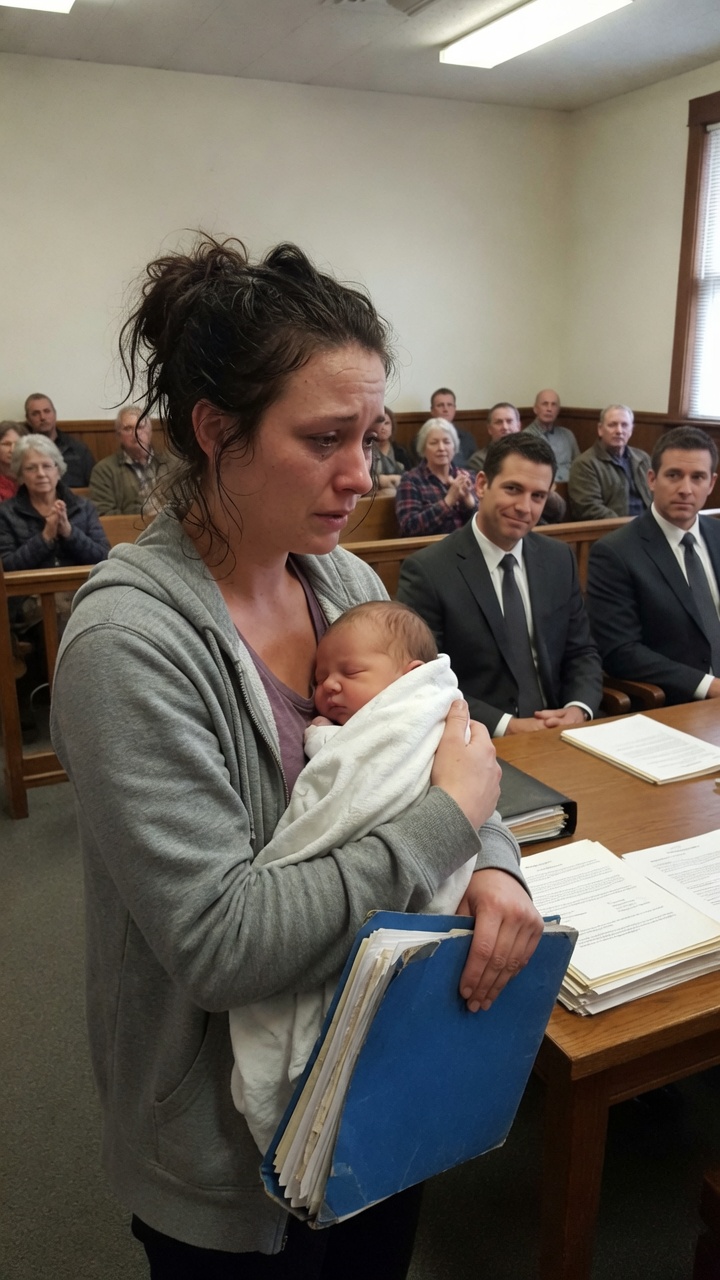

This Custody Hearing Folder begins inside a Tennessee courtroom where nearly everyone believed they already knew the outcome. Savannah Brooks arrived carrying her newborn son and a worn blue folder packed with documents. She looked exhausted, overwhelmed, and completely alone. Across the room sat her husband, Garrett Holloway, alongside an experienced attorney and family members who appeared certain victory was already theirs. To every observer, the hearing seemed like a simple legal formality. Yet hidden inside that Custody Hearing Folder was information that would challenge every assumption made about Savannah, her marriage, and the battle over her newborn child. Before the hearing ended, the contents of that folder would transform the entire case.
Part 1: The Custody Hearing Folder Arrives in Court
The morning air felt cold as Savannah entered the courthouse carrying her six-day-old son against her chest.
People watched her quietly. Some looked sympathetic. Others appeared skeptical.
Garrett Holloway sat confidently beside his attorney. His expensive suit looked flawless. His posture suggested complete certainty.
Beside him sat his mother, Lorraine Holloway. Nearby sat Garrett’s fiancée, Chelsea Monroe.
Savannah immediately noticed the bracelet on Chelsea’s wrist.
Years earlier, Garrett had given that bracelet to Savannah as an anniversary gift.
The sight hurt, but she refused to react.
Her focus remained on her son and the Custody Hearing Folder resting under her arm.
Only six days earlier, she had given birth.
Instead of spending her time adjusting to motherhood, she was defending her right to raise her child.
Garrett’s emergency petition claimed Savannah was emotionally unstable and incapable of providing proper care.
The allegations sounded serious.
The strategy appeared effective.
Most importantly, the accusations positioned Garrett as the supposedly stable parent.
While recovering in the hospital, Savannah had already experienced pressure.
Garrett refused to visit unless she agreed to sign temporary custody papers.
He described the arrangement as temporary.
She viewed it differently.
Once signed, those documents could become the foundation of a much longer legal fight.
When she refused, Garrett’s attorney appeared in her hospital room carrying paperwork.
His words remained burned into her memory.
He explained that judges valued stability.
He reminded her she lacked permanent housing.
He pointed toward counseling records connected to difficult events during her marriage.
The message felt unmistakable.
Give up now or prepare to lose later.
Yet Savannah had already begun preparing months earlier.
She noticed inconsistencies.
Promises changed.
Stories shifted.
Conversations seemed strangely coordinated.
The more she observed, the more concerned she became.
Instead of arguing, she started documenting.
Quietly.
Carefully.
Patiently.
Every email.
Every message.
Every conversation.
Everything eventually found its way into the Custody Hearing Folder.
When the hearing began, Garrett’s attorney presented a polished argument.
He described Savannah as fragile.
He questioned her circumstances.
He implied the newborn would be safer elsewhere.
The presentation sounded convincing.
Savannah listened without interruption.
She never raised her voice.
She never challenged the attorney directly.
Instead, she waited.
Then the judge invited her to respond.
Savannah stood slowly.
Holding her son close, she reached for the blue folder.
For the first time all morning, silence settled over the courtroom.
Garrett still smiled.
He believed he already knew what was inside.
He was wrong.
Part 2: The Custody Hearing Folder Changes Everything
Savannah approached the bench carrying the Custody Hearing Folder.
The judge accepted the documents and began reviewing them.
At first, nothing seemed unusual.
Then the judge paused.
He turned another page.
Then another.
The room became noticeably quieter.
The first section contained communications that directly contradicted statements made in the emergency petition.
Emails established timelines.
Text messages revealed inconsistencies.
Records challenged the narrative Garrett had presented.
The judge continued reading.
Garrett’s attorney objected.
The objection failed.
More documents followed.
The next section detailed repeated attempts to pressure Savannah into signing custody-related paperwork while recovering from childbirth.
The timing concerned the court.
Additional records documented months of interactions.
Requests.
Warnings.
Conversations.
Patterns.
Everything had been preserved inside the Custody Hearing Folder.
Garrett’s confidence slowly disappeared.
His relaxed posture stiffened.
The smile vanished.
Even family members sitting nearby appeared uneasy.
Then the judge reached the final pages.
Those pages contained Savannah’s most important evidence.
The records suggested portions of the custody strategy had been discussed long before the baby was born.
Documents appeared to show planning, preparation, and narrative-building that raised serious questions.
The courtroom remained silent.
No one interrupted.
No one moved.
Several spectators watched the judge carefully.
Minutes passed.
Finally, the judge looked up.
His decision was clear.
The emergency petition was denied.
The request for immediate custody transfer was rejected.
The court found insufficient grounds to remove the newborn from Savannah’s care.
Further concerns surrounding the filing would receive additional review.
Garrett remained speechless.
His attorney gathered papers quietly.
The confidence displayed earlier that morning had completely disappeared.
Savannah looked down at her son.
He slept peacefully throughout the moment that changed everything.
His tiny hand wrapped around her finger.
For the first time in months, she felt relief.
Not triumph.
Not revenge.
Relief.
The truth no longer needed defending.
It had finally been seen.
As people left the courtroom, Savannah remained seated briefly.
She reflected on everything that had brought her there.
The fear.
The pressure.
The uncertainty.
Every difficult moment had led to this outcome.
Outside, sunlight streamed across the courthouse steps.
Savannah held her son a little closer.
The battle had never been about defeating someone else.
It had always been about protecting her child.
The Custody Hearing Folder gave her the opportunity to tell the full truth.
That truth changed the direction of the case.
Years later, people would remember the hearing and the documents that stunned the courtroom.
Savannah remembered something different.
She remembered the moment she stopped being afraid to stand alone.
Because she discovered that facts, preparation, and determination could be more powerful than influence, appearances, or assumptions.
The strongest person in the room was the one everyone had underestimated from the beginning.
Lessons From the Custody Hearing Folder
The story of the Custody Hearing Folder demonstrates how preparation can matter when circumstances seem impossible.
It also reminds people that appearances rarely reveal the full story.
Assumptions can be powerful.
Facts can be even more powerful.
Sometimes the quietest person in the room is carrying the evidence that changes everything.
If this story resonated with you, please consider sharing it with your loved ones.